
BHOPAL: They are everyday
girls. Nothing in their appearance is unusual. It is only after they start
talking and look directly into your eyes that the light of determination,
courage and knowledge on a critical issue like child/early marriage shines
through.
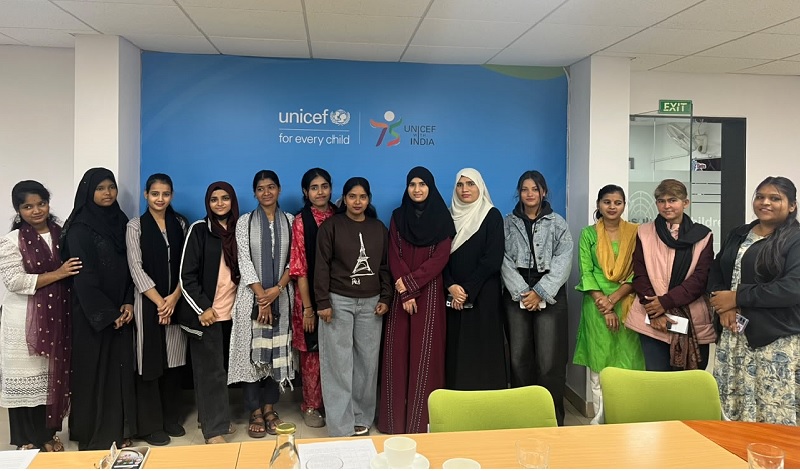
We met Tabassum, Masarrat, Sanjana, Ramvati, Zeenat, Shahida, Kahkashan and other young women like them at a meeting held at the UNICEF office of Madhya Pradesh on November 25 ahead of the First International Day for Elimination of Child, Early and Forced Marriage (November 27).
The stories they shared gave rise to hopes that it would be the young people who would take a determined and knowledgeable stand to ensure continuing reduction and finally elimination of the evil social practice of early marriage in Madhya Pradesh and India.
These girls, with support from social organizations that have provided them with necessary knowledge and a lot of backup, have managed to emerge as champions who have not only resisted their own early marriages in many cases, but also stood up against adults of extended families and communities to stop the impending underage marriages of other girls.
Not only this, they also actively counsel some of their own friends and peers who become insistent on getting into marriages at an early age after getting into relationships.
Tabassum (23) and Masarrat (18) are sisters from Arif Nagar in Bhopal. They belong to a modest family and despite the prevalent trend of early marriages among families in their locality and relatives, they are fortunate enough to have supportive parents who don’t buckle to social pressure and focus on their education.
But the sisters did not rest in ease because of their privilege. Members of NGO NIWCYD Bachpan’s Girls’ Icon Group, Tabassum and Masarrat started working with dropout kids from early age and moved on to creating awareness on child/early marriages.
“A 13-year-old girls’ engagement had been solemnized in our neighbourhood two years ago. We decided to meet her parents and counseled them about the negative impacts of an early marriage on girls – including discontinuation of education that could make them totally financially dependent in future, health issues as well as social and psychological issues like broken marriages,” Masarrat says.
The sisters are happy that they could stop the girls’ impending marriage and she was able to continue her education. Tabassum’s initiative helped in preventing underage marriage of four more girls whose engagements had been finalized. Though Tabassum says that many early marriages are still being conducted, she feels that sustained campaign can help in creating awareness.
Sanjana, 22, associated with NGO Muskan, had to overcome strong pressure from her family to get her marriage after class 10, when she was just 16.
“My parents felt that marrying me off during COVID-19 pandemic related lockdown would reduce the huge cost of ceremony. Also they were a bit worried about girls around us having love marriages at early age. But I resisted somehow,” she says.
Not only this, Sanjana took help of a Muskan volunteer to get herself enrolled in class 11 without informing her family and quietly studied at home during lockdown period. It was only during final exams that the Muskan volunteer visited her home and convinced her father to allow her to take the exam. “I scored 78% and suddenly my father was very proud. Then on I gained their trust and now am doing my MBA after my graduation and the same parents who wanted to discontinue my education have bought me a scooter to go to coaching and college and well as to attend Muskan meetings,” she says with a smile.
Sanjana actively works with migrant families from Rajasthan in her locality in Kotra to convince young girls and their parents to continue education despite fact that some of them were married off early and were waiting to attain adulthood to proceed to their marital homes.
Her friend Zeenat (22), who is pursuing MBA as well as an MSW degree, also faced immense pressure of marriage from family when she was just 16. However, she managed to convince her parents that after the marriage of her elder sisters (at ages 20 and 21), she had to be at home to help her ailing mother with domestic work.
“Slowly I managed to further convince them of importance of higher education and becoming financially independent and now they say that they would wait for the right time for my marriage. I want to give financial support to my parents as we don’t have brothers,” she says.
Shahida, who is a member of Children’s Core Group of NGO Aarambh tried to convince an acquaintance family not to marry off their daughter at 13. But the attempts to find groom for the young girl continued. “Then I threatened the mother of the girl, though in soft tones, that I will call police if they try to marry off the girl. This convinced them finally. They understood the points I made about girls not being ready physically and mentally for marriage at such tender age. I learnt all this from attending the Aarambh meetings.”
The extent of her knowledge on the issue, despite her young age, is highlighted by the fact that she even noticed the mental breakdown of a young man from her neighbourhood who was married off at 17 and was divorced a year later. She also She cites this example to many when convincing them of the ills of early marriage.
Another Aarambh core group member, Kahkasha (19) was also instrumental in stopping two early marriages in families she knew. She counseled the mother of one of such girls who was finally convinced when the family found out that the prospective groom was 35 years old while the girl was 16.
Ramvati, 20, faced sustained pressure, especially from her grandfather for marriage since she was 15. Her two elder sisters were married off just after they turned 18 respectively and the focus then fell on her. However, with the support of her mother, Ramvati has managed to ward off the pressure and is pursuing her graduation.
She joined NGO Aarambh in 2022 and this has increased not only her knowledge, but also her courage to resist the pressure. Also, now she counsels girls around her not to get into early marriages. “The trend of young girls getting into romantic relationship, which is actually mere attraction, and wanting to get married even before turning 16 is something that worries me. But I have been able to convince some of my friends against such decision,” she says.
Shahida also back Ramvati up on this issue and says that these days, it is as important to convince the girls not to fall for wrong alliances out of attraction at young age, as it is to convince their families not to marry them off early.
Madhya Pradesh shows dip in early marriages
The determination and efforts of these girls and the organizations they are associated too is certainly showing positive impact on the trend of early marriages in Madhya Pradesh.
Compared to 32.4% women getting married before age of 18 as per fourth edition of National Family Health Survey (NFHS) of 2015-16, the percentage came down to 23 in NFHS-5 (2019-20) and further down to 20 in NFHS-6 (2023-24), a fact sheet shared by UNICEF showed.
The difference is marked in early marriage prone districts like Rajgarh where marriages of girls below 18 years came down from 46 to 23 between NFHS 5 and 6. In Sheopur, it reduced from 39.5 to 25.3, while in Chhatarpur it went down from 39.2 to 22.5.
State Government to hold special Gram Sabhas
The Madhya Pradesh government will be holding special public awareness programmes aimed at preventing child marriage will be held on November 27, coinciding with the day.
Special Gram Sabhas (village council meetings) will be organized in every Gram Panchayat across the state on the day. A collective pledge will be taken on the occasion to neither engage in nor permit child marriage. Local elected representatives, women, youth, and social organizations will participate in the programmes.
Information regarding the adverse consequences of child marriage, relevant legal provisions, and children's rights will be disseminated in villages. In urban areas, the message of awareness will be conveyed through ward-level meetings and community events, a state government release said.
The events would be part of the 'Child
Marriage-Free India' (Bal Vivah Mukt Bharat) campaign drive by the Government
of India being held from October 21 to December 21.