

Special Correspondent
NewsBits.in
RAIPUR: Sirpur, the ancient town situated on the banks of the Mahanadi River in Mahasamund district of Chhattisgarh, has been included in UNESCO’s World Heritage tentative List under the name Sirpur Cultural and Archaeological Landscape.
With this inclusion, Sirpur is on the way to become a world heritage site. Chhattisgarh has achieved a significant milestone in its efforts to secure international recognition for its rich historical, cultural and archaeological heritage, a government note said.
The inclusion marks an important step towards bringing Chhattisgarh’s rich cultural heritage to the global stage. The ancient township is renowned for its ancient temples, Buddhist monasteries, rare sculptures, architectural splendour and tradition of religious tolerance.
Under the leadership of Chief Minister Vishnu Deo Sai, the state government has been making sustained efforts to conserve and promote Chhattisgarh’s historical and cultural heritage and establish it on national and international tourism maps. Under the guidance of Tourism and Culture Minister, Rajesh Agrawal, special emphasis is being placed on securing global recognition for important archaeological sites and expanding opportunities for cultural tourism, the note added.
Sirpur’s inclusion in UNESCO’s Tentative List is being viewed as a significant achievement in this direction. It is expected to enhance international awareness of Sirpur’s historical importance and strengthen prospects for future tourism development.
Ancient Capital of Dakshina Kosala and a Centre of
Religion and Culture
Sirpur’s history embodies the remarkable heritage of Indian civilisation, religious tolerance, cultural synthesis and architectural excellence. Known in ancient times as Shripur, the town served as the capital of Dakshina Kosala under the Panduvamshi rulers. Situated on the banks of the Mahanadi, it was a major centre of political, religious, cultural and commercial activity.
Important evidence of Sirpur’s antiquity has been found in copper-plate inscriptions of Sharabhapuriya rulers Pravararaja and Mahasudevaraja. During the approximately 57-year reign of Panduvamshi ruler Mahashivagupta Balarjuna, Sirpur attained new heights of cultural and architectural development.
Numerous temples, Buddhist monasteries, ponds and gardens were constructed during this period.
The renowned Chinese traveller Xuanzang also visited the region in the seventh century. His travel accounts refer to the flourishing Buddhist tradition here. Historical descriptions mention approximately 100 Buddhist monasteries and around 10,000 monks belonging to the Mahayana tradition in the region during that period.
One of Sirpur’s most distinctive features is the coexistence of Shaivite, Vaishnavite, Buddhist and Jain religious traditions. Although Mahashivagupta Balarjuna himself followed Shaivism, he generously donated to and supported Buddhist monasteries. This reflects Sirpur’s importance as a significant centre of religious tolerance and cultural synthesis in ancient India.
Lakshman Temple: An Outstanding Example of Ancient Indian Brick Architecture
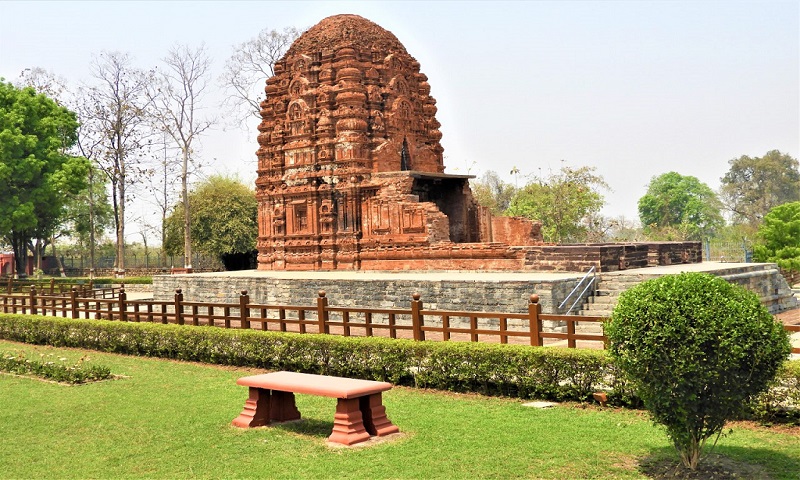
Sirpur’s world-renowned Lakshman Temple is regarded as one of the finest achievements of Indian architecture. Built around the seventh century, it is among the finest surviving examples of ancient Indian temples constructed primarily of brick. Its grandeur, artistic ornamentation, intricate carvings and construction techniques demonstrate the extraordinary skills of the artisans of that period.
Standing on a stone platform approximately seven feet high, the temple follows the pancharatha architectural style and comprises a sanctum, an antechamber and a mandapa. Its exterior walls feature chaitya-window motifs, elephants, kirtimukhas, load-bearing ganas and various ornamental designs.
Similarly, situated on the sacred banks of the Mahanadi, the Gandheshwar Mahadev Temple is an important centre of Sirpur’s religious heritage. Known in ancient times as Gandharveshwar, the temple continues to be a major place of worship for devotees.
Major Centre of Buddhism, Home to Remarkable Architecture and Monasteries
Sirpur was an important centre of Mahayana Buddhism in ancient India. Archaeological excavations have revealed the remains of numerous Buddhist monasteries, which had well-organised arrangements for meditation, study, teaching and the accommodation of monks.
Among Sirpur’s prominent Buddhist monasteries, the Anandprabhu Kuti Vihara and Swastik Vihara are particularly noteworthy. The Anandprabhu Kuti Vihara was built during the reign of Mahashivagupta Balarjuna by a Buddhist monk named Anandprabhu. Its identification is supported by epigraphic evidence.
Excavations conducted in Sirpur in 2002–03 under the direction of Dr Arun Kumar Sharma revealed the remains of Teevardeva Mahavihara. Covering approximately 902 square metres, the monastery is among the significant Buddhist architectural sites of Dakshina Kosala.
Located about one kilometre east of the Lakshman Temple along the Kasdol road, the mahavihara is notable for its scale, ornate entrance and remarkable craftsmanship.
More Than 2,000 Archaeological Finds Reveal Sirpur’s Glorious Past
Archaeological excavations conducted at Sirpur in different phases have uncovered numerous layers of the ancient town’s rich history. More than 2,000 artefacts have been recovered during these excavations.
These include metal sculptures, sculptural panels, tools used in jewellery-making, iron vessels, locks, chains, lamps, ritual vessels, earthen pots, glass bangles, terracotta seals, toys and ancient coins.
A Chinese coin discovered at Sirpur is particularly significant. It is believed to date to the reign of the Chinese emperor Kaiyuan. Coins associated with Sharabhapuriya ruler Prasannamatra and Kalachuri ruler Ratnadeva have also been recovered. These finds provide valuable information about Sirpur’s ancient commercial, economic and cultural connections.
Sirpur was renowned for the production of fine metal sculptures during the seventh and eighth centuries. The images created here represent a distinguished tradition of Indian metal sculpture.
An important hoard of metal sculptures was discovered at Sirpur in 1939. These include figures of Lord Buddha, Avalokiteshvara, Padmapani, Vajrapani, Manjushri, Tara, Rishabhanatha and Lord Vishnu.
The facial expressions, expressive eyes, hand gestures, flowing folds of garments and intricate ornamentation of these sculptures reflect exceptional artistic skill.
Many metal sculptures recovered from Sirpur are preserved in museums and institutions in Raipur, Nagpur, New Delhi and Mumbai. These artworks have also been exhibited in countries including England, Germany and the United States, underscoring the international significance of Sirpur’s artistic heritage.
Inclusion of Sirpur in UNESCO’s World Heritage Tentative List is expected to give fresh direction to opportunities for cultural, historical, religious and archaeological tourism in Chhattisgarh.
Greater international recognition could attract more tourists, historians, archaeologists, researchers and followers of Buddhism from India and abroad. This could also create opportunities to expand tourism services, hotels, homestays, transport, handicrafts, local cuisine and other employment-generating activities.


