
Now a scansion tool for Urdu poetry to unlock hidden chambers of 'Arooz'


Shams Ur Rehman Alavi
NEWSBITS.in
While Urdu poetry is immensely popular and the couplets travel across the world, quoted widely in conversations, there is an element of mystery about 'Aruuz'--the difficulty in understanding the craft behind the compositions. Aruuz [arooz] or prosody has been a major challenge for students, writers and even many in the literary community.
Either 'ghazal', the most important genre of Urdu poetry or 'nazm', the verses are generally expected to follow the rules of 'arooz'. In the past, veteran poets guided the new generation of poets and told them the nuances of language as well as craft of poetry and abve all, adhering to the requirements of the Urdu meter--all the couplets in a nazm or a ghazal, are supposed to follow one of the few traditional meters.
The norms are tough, the rules appear to be overwhelming initially and it all becomes intimidating for a budding poet because its tough to locate anyone who can guide and even though not everyone knows the system, audience or readers are quick to spot a lapse. Hence, a poet is expected to be knowing the system, even if he or she writes Nasri Nazm, Azad nazm or other forms of poetry that have relaxation in terms of meter and rhythm.
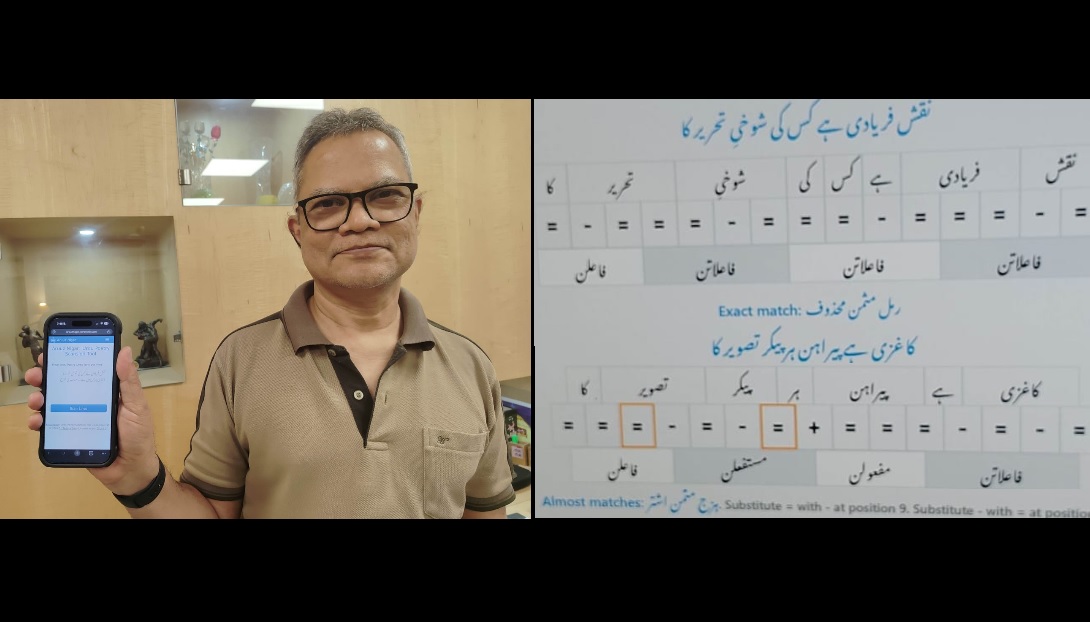
Tarique Sani, a doctor, who is also an avid IT expert, has come up with a tool, Aruuz Nigar. The tool is available on the internet and those who are always on the lookout for a teacher to know the basics of the craft of Urdu poetry, can check any couplet (or their own compositions) and find out information about its meter.
It is available on Github and can be downloaded on desktop or laptop, where one can use it to find the meter and also go to 'islaah' section for correction. It helps young poets to examine the status of their own compositions and it even helps them find out the fault, so that they can resolve it by going to the 'islaah' section.
There are certain options but Tariqe wanted to bring a system that would help future generations and would not have the developer or company's propriety. "Aruuz Nigar is open source. It breaks poetry into its rhythm and helps in finding the meter. It is a Python engine and a simple web interface to make aruuz feel less than a secret code. It will help user learn the art", he explains.
Sani says that everyone knows that learning aruuz is important but few learn it to the required depth because it is often taught in a 'because that's how it is' style. "I had to learn the arooz before working on it. It is 85,000 lines of code and it is open source, anyone can see the code. His wife, Swati Sani, who had established a IT company years ago, is also a Urdu poet.
Tarique's mother late Zarina Sani was a renowned Urdu litterateur and her multi-lingual book that has words with meanings and each word having a Urdu couplet that carries the word, remains a besetseller. Aruuz has always been a tough subject and certain poets find a way to adhere with the system, without going deeper into it.
This traditional system ensures that not just couplets, but long ghazals and nazms, are memorized. The pattern makes it easy for brain to learn them.It is not just 'radeef' and 'qaafiya' which ensure rhyming, there is a complete system that one has to learn. Classical masters somehow knew the art and the seniors corrected the faults in the couplets of disciples and told them how to ensure that there was no mistake in poetics. It is a tough subject and took decades to master.
Many poets are able to write as per requirements of meter either because they have a natural felicity or they learn the system just enough to avoid a mistake, but for a young person or a student, the books on the subject are too deep. There are rules and also there are exemptions as liberty can be taken in case of certain words due to the pronunciation--Urdu meter is based as per the word is spoken, pronunciation is the key to break words and decide the pattern. The tool is available at this link [https://tariquesani.github.io/aruuz-nigar].